
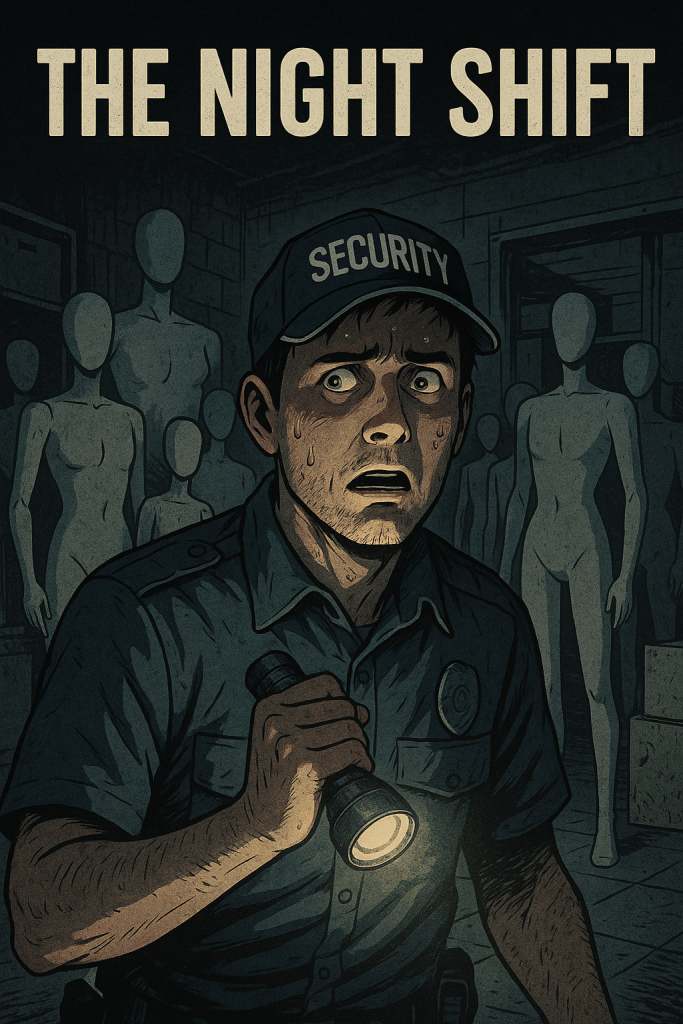
Aiden McQuinn stood before the cracked mirror in his dimly lit apartment, the fluorescent bulb above casting a pallid halo over his features. He adjusted his hair with mechanical precision, though his smile—tenuous and brittle—belied the ritual’s intended comfort. It was not joy he felt, but the peculiar sense of relief that often follows chaos. A few weeks earlier, his world had been dislodged. Terminated from his position as warehouse foreman despite adhering with servile diligence to his superior’s every directive, he had drifted through days of muted fury and sleepless nights. His dismissal had not shattered him, but it had carved something out.
Then, from some unseen quarter of Providence, came the offer. Night watch at a large, suburban mall known as The Ridge—a name that felt oddly geological, as though perched above something vast and unseen. The pay was curiously generous. Almost… suspiciously so. Yet Aiden, weary of brooding in his solitary confines, accepted with little protest.
As he prepared to leave, he allowed himself a final glance in the mirror, whispering the words his father had once spoken every morning before work: “You got this, big boy.” A mantra half-prayer, half-tribute. Thirteen years had passed since his father’s death, and still, the echo of the man’s voice lingered in the walls of Aiden’s thoughts, haunting not with dread, but with longing.
The night air outside greeted him like a chilled balm. He donned his jacket, flicked the switch to extinguish the wan light behind him, and locked the door with the familiarity of a rite. The streets stretched before him, empty veins in the sleeping town, and he began the thirty-minute trek toward the distant structure whose roofline now flickered faintly beneath the cloudy sky.
The Ridge awaited. Aiden breathed deeply, the scent of wet concrete and dying leaves filling his nostrils, and exhaled into the stillness. Beneath his breath, almost reverently, he repeated: “You got this, big boy.”
As he finished his brisk walk, the Ridge loomed before him, its vast glass frontage aglow with artificial light, bathing the parking lot in a sterile, unwavering luminescence. Even at this hour—long after the last patrons had filtered out and the escalators stood frozen mid-ascent—the building seemed… aware. There was no decay here, no ruin or rust to hint at forgotten histories. It was new, alive in a way that should have comforted. But standing before it, Aiden felt the skin on his neck tighten as if some deep part of him bristled against an ancient instinct.
It was just a mall. That’s what he told himself. Just a massive, successful, suburban monument to commerce and convenience. Its signs were bright, its windows clean, its food court still faintly perfumed with synthetic cinnamon and frying oil. But even so, a strange hush had settled over the landscape. Not silence—no, the air still hummed with electricity and the distant whir of HVAC systems—but a quiet that felt like something holding its breath.
Aiden paused near the service entrance where he’d been instructed to report. The double steel doors were unmarked, save for a small keycard panel, blinking red in patient anticipation. Above, security cameras turned with insectile precision, tracking unseen movements.
He pulled his badge from his coat pocket and swiped it. The panel clicked, obediently green, and the door gave a reluctant groan as he pushed it inward. The air inside was cooler, stiller—stale with the scent of linoleum, old receipts, and cleaning agents that couldn’t quite mask something… older.
As he stepped inside, he let the door close behind him with a resonant thud that seemed to echo far longer than it should. The mall was quiet now, resting, perhaps—but something about its silence did not suggest sleep.
He muttered once more, this time under his breath, like a charm against the dark:
“You got this, big boy.”
No reply came. But somewhere deep within the mall, beyond the vending machines and shuttered kiosks, a light flickered—and did not return.
The hallway beyond the service entrance stretched long and nondescript, lit in pale green fluorescence that flickered faintly as if unsure of its purpose. Aiden followed the directions he’d been given, passing stacks of cleaning carts and a sagging vending machine humming a dull, irregular tune. Eventually, he found the door labeled Security Operations Center, its letters partially scuffed, as though time had taken slow bites from the paint.
He knocked once before pushing it open.
Inside, the room was dim and close, filled with the glow of surveillance monitors — a mosaic of still images capturing every corridor, shopfront, and atrium under artificial light. The air was heavy with the scent of burnt coffee and old electronics. At the center sat a stocky man in a threadbare swivel chair, his bulk slouched with the practiced weariness of someone who had seen everything and cared for none of it.
“You McQuinn?” the man asked without looking up.
“Yeah. Aiden. First night.”
“Mm. Lucky bastard. Sit down.”
Aiden obeyed, settling into the creaking chair beside him.
“Whelan,” the man said, rubbing at the dark crescents under his eyes. “I’ve been here too long. You’ll figure things out.” He jabbed a thick, stained finger at the glowing monitors. “That’s your map. Cameras don’t see everything, and they weren’t meant to.”
Aiden looked closer. “Some blind spots?”
“All over,” Whelan grunted. “Don’t bother reporting it. Corporate don’t care, and you’ll just look like you’re trying too hard.”
He pushed himself to his feet with a noise that was half sigh, half grunt. “Come on. Tour time.”
The mall was different at night — cavernous, humming, and empty in the way deep caves are empty. Whelan led him past maintenance doors, emergency exits, and power boxes humming with invisible currents. The janitor’s closet, he said, was best avoided after midnight — not for any real reason he’d explain, just a look that said: don’t ask.
Finally, they stopped beneath the glass dome of the central atrium, a silent cathedral of commerce stretching out in all directions.
“Looks clean, don’t it?” Whelan murmured. “Like a place where nothing’s ever gone wrong.”
“Yeah.”
“Well. Keep your rounds. Don’t sleep on shift. Don’t try to be a hero. You see something strange? Take note and move on. Curiosity’s not part of the job description.”
Aiden frowned slightly. “That’s it?”
Whelan handed him a battered ring of keys. “You’ll learn what matters.”
And with that, the older man turned and walked away, his footsteps echoing long after he vanished into the corridors. The doors whispered shut behind him with a sound like the breath of something enormous exhaling.
And then Aiden was alone.
The silence inside The Ridge was not absolute, but had a character of its own — a gentle static made of distant hums, faint electrical ticks, and the breathless absence of footsteps not taken. Aiden’s boots echoed softly on the polished tile as he began his rounds, flashlight in hand, the beam slicing through long shadows cast by high-ceilinged store facades. The mall, so vibrant in daylight, now resembled the husk of a creature that had once moved and breathed and spoken.
He passed a cell phone kiosk, its ads looping silently on dimmed screens. A smoothie bar, wiped clean but still faintly scented of fruit syrup and disinfectant. A shoe store with rows of empty pedestals like altars to vanished gods.
He breathed in the stale air — not foul, but aged, settled. As though the mall exhaled something old and slow that had been lying beneath the linoleum for years.
Then he stopped.
Just outside a hunting and outdoor supply store — Elk Ridge Outfitters, its sign carved with stylized antlers against a silhouette of pine trees — lay a mannequin.
It wasn’t standing. It wasn’t in a window display. It was on the floor — sprawled across the tiled walkway in a posture that made his skin crawl. It lay on its stomach, the head tilted upward as though peering toward something just out of sight. One leg bent, the other straight — the left arm extended forward mid-sprint, while the right arm was curved jauntily at the hip in a disjointed, almost mocking pose.
The expressionless face — featureless save for molded contours — stared upward with that smooth, blind gaze common to mannequins. And yet… something about it suggested intention. A stillness not born of plastic, but of choice.
Aiden froze, flashlight beam held steady on the pale figure. It was absurd. Just a mannequin. But something about it — lying there like a puppet dropped mid-performance — felt… off.
Elk Ridge. He’d hiked that trail more than once in his life. Slept beneath the same trees carved into the sign above this storefront. There was something familiar here. And that made it worse.
He crouched beside the mannequin, the cold plastic slick beneath his fingers. It was heavier than he expected. As he lifted it upright, one of the arms shifted on its joint with a soft click — falling into a new, equally uncanny pose.
“Where were you supposed to be?” he muttered, glancing through the window.
Inside the store, no empty platforms. No display pedestals. Just racks of jackets, rows of boots, a stuffed fox mounted on a wooden crate, and the faint scent of pine-scented cleaner.
He glanced around — no other mannequins nearby. No signage. No open boxes. Just him, the faint buzzing of overhead lights, and the silent sentinel in his arms.
He didn’t know where it belonged. There were no display stands, no dressing platforms, no open boxes — just racks and shelves and walls. It shouldn’t be here. Not like this. Aiden hesitated a moment longer, then gently set the mannequin down beside the glass door of Elk Ridge Outfitters. It leaned slightly when he released it, as though unwilling to stay upright on its own.
He stepped back, frowning at the pale figure — its limbs frozen in mockery of motion, its blank face tilted just so. The longer he looked at it, the more certain he became that it hadn’t simply fallen. No—it had been placed. Or had wandered.
His skin prickled. Now that was an unwelcome thought.
“Storage,” he thought. “There must be a place they keep extras.”
He turned on his heel, boots clicking faster now as he retraced his steps along the mall’s back corridor. He hadn’t been given a full layout yet, but he remembered passing a sign — Main Storage — during Whelan’s haphazard tour. A wide double door near the loading dock. He followed the memory through turn after turn, passing shuttered storefronts and dim corners until he found it.
The door was slightly ajar.
He paused, swallowing the tightness in his throat. He licked his lips in desperation as he moved his shaking hand forward. He pushed the door open with the edge of his flashlight.
The air inside was different — colder, heavier. It smelled faintly of mothballs and treated fabric. Shelves loomed in shadow, stacked with boxes and seasonal signage. And mannequins.
Dozens.
They were arranged with no sense or system, their limbs bent at unnatural angles, as if frozen mid-convulsion. Some stood rigid, their hands raised. Others leaned against the walls like loiterers at a silent funeral. One was upside down in a wire bin, legs stiff in the air. Another was propped in a child-sized wheelchair, head drooping forward, arms spread like wings.
Aiden let out a sharp, involuntary sound — a half-shout, half-gasp that echoed back at him too clearly. He backed against the door, flashlight trembling slightly in his grip as the beam flitted across blank faces and glossy torsos.
No two were posed the same.
Some had limbs missing. Some had hands turned backwards. A few had faint smudges — fingerprints, maybe — on their smooth surfaces, as though someone had recently handled them.
He took a slow step backward, then another. None moved.
But he felt them all watching. Waiting.
As he stood frozen in the doorway, surrounded by the silent chorus of plastic limbs and eyeless faces, Whelan’s words drifted back through the fog of Aiden’s rising panic:
“You see something strange? Take note and move on.”
His breath hitched. He clenched his jaw. The instinct to run scraped against his spine like a wire, but he forced himself to breathe — slow, measured — as if trying not to disturb the air itself.
He stepped back. Reached for the handle.
With deliberate care, he shut the door. The latch clicked shut with a finality that seemed louder than it should have. He paused, waited. Nothing stirred behind it.
Then, hand still shaking, he turned the lock.
He didn’t look back.
The walk back to Elk Ridge Outfitters felt longer, as though the corridors had subtly changed length, warping under some hidden pressure. The silence had returned, but it no longer felt passive. It now pulsed with a rhythm just beneath perception — a beat he couldn’t hear, but which his nerves had begun to echo.
He rounded the corner and stopped cold.
The mannequin was gone.
The spot beside the door was empty — clean, undisturbed, as though it had never been there at all. No scuff marks. No drag trails. No sign of where it had gone.
Aiden stared, mouth slightly open, light quivering in his grip.
“No. No, I brought it here. I set it right here,” he said to himself, trying to make sense of the chaos.
His eyes scanned the storefront window, the hallway behind, the dark angles of the ceiling — but there was nothing. Just shelves of jackets, orderly rows of boots, and the unblinking darkness beyond the glass.
Slowly, Aiden exhaled.
“Take note,” he whispered to himself, voice thin, “and move on.”
He decided to return to the security office, to impose order on the chaos. The walk back to the security office felt longer than it had before — not in distance, but in gravity. Each step came heavier than the last, as though the air thickened with every breath. The flashlight’s beam trembled across white tile and locked doors, painting fleeting shadows that seemed to hold their shape a moment too long.
Aiden’s breath came shallower. Not panicked, but taut — drawn between the need for calm and the tightening coil in his chest. It wasn’t the absence of sound, but its burial — a silence so suffocating it seemed to press into his skin, slow and cold.
“I put it down. I know I did. I am sure of it,” he mumbled to himself.
His boots echoed off the walls. He kept looking behind him. Nothing. Just empty corridors, clean tile, distant flickers of light.
Could someone else be here? Another guard? A prank?
But Whelan hadn’t mentioned anyone else. And this… this didn’t feel like a prank.
When he finally reached the door to the Security Operations Center, he paused. His hand hovered at the handle for a second too long, then gripped it, twisted, and pushed.
Inside, the monitors still glowed in their quiet vigil — sterile, impartial, each one fixed on a segment of the mall now seemingly carved from stone. He stepped in slowly, his eyes scanning the feeds.
Nothing.
The hallway by Elk Ridge Outfitters — empty.
The atrium — undisturbed.
Even the corridor to the storage area lay still, light buzzing faintly through the feed’s grain.
No mannequin. No movement. Nothing at all.
Aiden stared, mouth slightly open, the light of the monitors washing his face in a pale flicker. He felt the doubt rise — slow, bitter, insidious. Had he imagined it? Was the weight in his hands real? Was any of it real?
He replayed the moment in his mind: the cold plastic under his fingers, the way its joints had clicked. The smell in the storage room. The echo of his own startled cry. That wasn’t in my head. That wasn’t—
BANG.
The sound shattered the silence like a hammer through glass — sudden, brutal, and close. It echoed down the hallway, metallic and deep, like something massive had fallen onto concrete. And his train of thought derailed. Aiden flinched, heart lurching against his ribs. He turned instinctively toward the door.
Storage.
The sound had come from the direction of the storage room.
He stared at the hallway feed. Still nothing. Why wasn’t there a camera in the storage room? Of all places, it seemed like the first a robber would target.
His fingers hovered over the radio at his belt. His breath came faster now, shallow and ragged, the panic no longer creeping but sprinting.
Something had moved. Of that he was sure.
Aiden backed away from the monitors, one trembling hand drifting toward his jacket pocket. He pulled out his phone — fingers stiff, breath shallow — and unlocked the screen.
No signal.
The bars were dead. Not low. Not flickering. Just gone.
“What the hell…” he muttered, tapping the glass. He moved toward the door, tried stepping into the hallway. Still nothing. No bars. No emergency call option. Just the dead screen silently mocking him.
He turned toward the old desktop computer humming quietly in the corner of the office. It was ancient, patched with tape over a cracked USB port, but maybe — just maybe — it could connect to something.
He jiggled the mouse. The screen flickered to life. The default login screen blinked at him — plain, unassuming. He entered the password Whelan had scrawled on the post-it note by the keyboard.
The desktop loaded. He opened the browser.
A blank tab.
He waited. Reloaded. Waited again.
No connection.
He opened the network settings — his pulse accelerating with every click.
Disconnected. No networks found.
“That’s not possible…” he whispered. “This place runs on Wi-Fi. It has to.”
But the system sat coldly inert. Cut off. Just like him.
Panic lanced through his chest. His breath shortened. The room seemed to grow smaller, the monitors too bright, the walls too close.
“I need to get out. Now,” he said to himself firmly.
He spun toward the door, yanked it open, and strode into the hallway — no longer trying to be quiet. The nearest exit was the service door he’d entered through. Straight down the west hall.
He reached it in less than a minute, only to find it sealed.
Not locked.
Blocked.
A heavy maintenance cart had been jammed into the narrow corridor before the exit. One of the mop buckets had spilled, water pooling like a small lake beneath the wheels. Cleaning supplies were scattered across the floor, but there was no sign of who – or what – had left them.
“That cart wasn’t there before,” he whispered. Then, more quietly still:“You got this, big boy.”
The mantra didn’t help this time. Aiden stood frozen – breath tight, pulse wild.
There was another way out. The fire exit… through the storage corridor.
He turned slowly, stomach tightening, and looked back toward the hall he’d walked earlier.
Back toward Main Storage.
The door was still closed — and at its threshold stood a silent legion of plastic men, waiting. Guarding it.
The mall felt larger now, as if the corridors had stretched in the darkness, reshaped by his fear. Aiden crept through them, slow, deliberate, his steps muffled against the tile — each one measured like it might trigger something unseen.
Every sound made him flinch.
A soft clatter somewhere near the food court.
A low thud echoing from the upper level.
The faint mechanical whir of a vending machine coming to life unbidden.
None of it should have meant anything. But it all did. It reminded him of how unwelcome he was in this place.
His breath came in quick, shallow pulls, and his heartbeat rattled inside his chest like a trapped animal. He moved through the sterile glow of the emergency lights, their low hum pulsing behind his ears like tinnitus.
Step by step, the hallway narrowed in his mind.
Until at last, he stood before the door. The door to Main Storage — where the insidious mannequins waited for him.
He reached out with a trembling hand, fingertips hovering over the metal handle.
The surface was cool. Too cool.
His skin recoiled, but his grip tightened.
He turned the lock.
CLICK.
The sound rang out like a gunshot in the quiet.
Aiden winced, his pulse pounding in his ears. His breath was rapid, his eyes wide.
Slowly, painfully, he pulled the door open — the hinges groaning like a warning from the ancient bones of the building.
He leaned forward, flashlight cutting a pale crescent into the darkness inside.
The mannequins were still there.
Posed. Waiting.
Silent.
He exhaled — barely — and stepped forward, foot just inside the threshold. Freedom lingered just ahead — he could almost smell it. He quickened his step and as he was nearing the door, he felt it. Something grabbed his shoulder.

 Temple of Morrbanesh